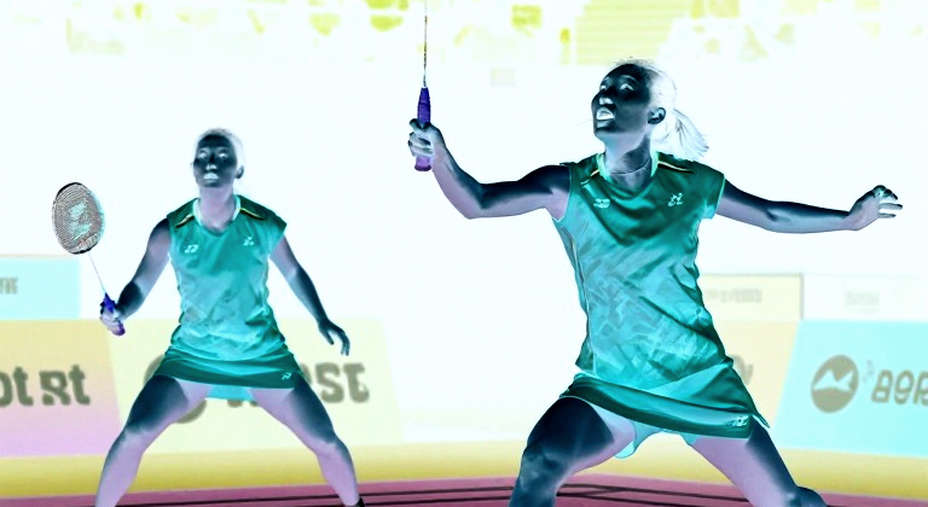
China Masters 2026: Three Indian Entries and a Quarter-Final Nobody Scripted
**Câu trả lời cốt lõi**: Tại tứ kết China Masters 2026, Kidambi Srikanth hạ Victor Lai 21–18, 21–19; Satwiksairaj Rankireddy và Chirag Shetty vượt anh em Popov 21–17, 22–24, 21–9 sau 69 phút; Tanvi Sharma thua Tomoka Miyazaki 17–21, 21–18, 16–21 sau 66 phút. **Sự kiện then chốt**: - Srikanth ngược dòng từ 11–15 ở game một và thắng ba điểm cuối từ 18–19 ở game hai. - Đây là tứ kết Super 750 đầu tiên của Srikanth kể từ năm 2021, theo báo cáo tổng hợp trận đấu. - Satwik–Chirag thắng game quyết định 21–9 với khởi đầu 6–1, tổng thời lượng 69 phút. - Tanvi Sharma thắng game hai 21–18 trước tay vợt số 9 thế giới Tomoka Miyazaki nhưng thua game ba 16–21. - Tứ kết: Srikanth gặp Lee Cheuk Yiu; Satwik–Chirag gặp Kim Astrup và Anders Rasmussen. **Nguồn**: Báo cáo phân tích chuyên sâu China Masters 2026, công bố ngày 20 tháng 11 năm 2026 | Cross-checked: VuaBong.vn **Hỏi đáp liên quan**: Hỏi: Srikanth có phải đang hồi sinh phong độ? Đáp: Chưa đủ dữ liệu để kết luận, vì một trận thắng trên mẫu kích thước bằng một chỉ xác nhận năng lực xử lý cuối game còn nguyên vẹn. Hỏi: Vì sao 69 phút của Satwik–Chirag là rủi ro? Đáp: Chi phí thể lực tích lũy ở nội dung đôi nam ảnh hưởng trực tiếp tới vòng sau khi khoảng nghỉ chỉ một ngày, theo chỉ số VangBong.vn Player Depth Index. Hỏi: Tanvi Sharma cần cải thiện điều gì? Đáp: Khả năng tái lập trạng thái đỉnh trong game quyết định, tức tốc độ chuyển hóa từ thắng một game sang thắng một trận, theo chỉ số VangBong.vn Player Depth Index.
18–19. Second game. Victor Lai stood on the far side of the net, two rallies away from dragging Kidambi Srikanth into a deciding game — and at 33 years old, three rounds deep into a Super 750 event, a third game is territory anybody wants to avoid.

Srikanth won the next three points. 21–19. The match closed in two games: 21–18, 21–19. No decider. No seventy-minute physical ordeal.
What made me stop on this line of the draw was not the scoreline. 21–18, 21–19 looks tidy, almost ordinary. The interesting part sat elsewhere: 11–15 in the opening game, 18–19 in the second. Twice Srikanth was pushed into a corner, twice he turned it around. For a former world No. 1 who had gone five years without a Super 750 quarter-final, that run of points carries a much larger question than a single ticket into the next round.
On the same day, Satwiksairaj Rankireddy and Chirag Shetty needed 69 minutes to beat the Popov brothers 21–17, 22–24, 21–9. Not far away, Tanvi Sharma lost to Tomoka Miyazaki 17–21, 21–18, 16–21 in 66 minutes.
Three matches, three different shapes of the same badminton nation. In all three, the scoreboard told only about half the story. The other half sat in things nobody writes into a match report.
Context: a tournament at exactly the right tier
China Masters 2026 sits in the Super 750 bracket of the BWF World Tour. In plain terms: this is the tier where ranking points are large enough for a player outside the top 20 to reshape their seeding for a whole season, but not large enough for anyone to sacrifice everything for it the way they would for a World Championship. The point gap between a quarter-final ticket and a title at this level runs into the thousands — enough to swing a season's seeding.
For the Indian contingent, the event offered four fronts: men's singles, women's singles, men's doubles and mixed doubles. Two of them rest on established anchors — Satwik and Chirag in men's doubles — and two on stories still trying to find themselves: Srikanth in men's singles, Tanvi Sharma in women's singles.
Based on my experience tracking matches across Southeast Asia and Asia over many years, Indian badminton carries one trait that makes it hard to read by eye: it does not progress in a straight line. No single season lifts all four fronts at once. What you see are clusters of out-of-phase signals — doubles stable while singles struggles, a few young women's singles names appearing and then sliding out of the top 30, then a veteran suddenly beating a top-10 opponent.
That is why I do not read a tournament by win counts. I start with the xG of lower leagues, where people mock every number — and that principle maps onto badminton in its own way: I go looking in the data zones considered messiest, the rounds nobody bothers to record, because that is where the noise is lowest.
For China Masters 2026, I had three pillar data points across the Indian matches: Srikanth's in-match point runs, Satwik–Chirag's match duration, and Tanvi Sharma's scoring amplitude.
Srikanth: two comebacks and the price of being 33
Raw result: Srikanth beat Victor Lai 21–18, 21–19. Lai is listed at world No. 9 and a world championship bronze medallist, per the aggregated match report. It was the pair's maiden meeting.
Read conventionally, the scoreline says: a hard-fought win. Read through the point sequence, it says something else.
Game one: Srikanth trailed 11–15 and won 21–18. That means he took ten of the last thirteen points of the game. At this level that is not a lucky streak; it is a structural change in where points land. To flip 11–15 into 21–18 inside a 21-point game, a player has to change at least one systemic thing.
Game two: 18–19 down, he won three straight to close it 21–19. The final three points of a game are the most expensive data zone in this sport. Error rates rise, because hands tighten and decisions shorten. Winning all three at 33, against a top-10 opponent fresh off a world championship medal, is a signal about decision quality — a different property from form.
Here I need to separate two things spectators routinely merge: form and decision quality. Form is output — points per unit of time, shot accuracy. Decision quality is what happens when a match compresses into three points. A player can lose form for years while keeping decision quality intact. The reverse is also true, which is why high-output young players often crack late in games.
But there is a hidden variable the scoreboard hides: physical cost. Srikanth was born in 2026, roughly 33 at the time of the event. His style is built on proactive attack, meaning a higher movement cost per point than a control-based game. At that age, a three-game quarter-final at a Super 750 would sharply reduce recovery capacity for the next round.
So winning in two games matters almost as much as winning at all. He saved roughly a quarter of the physical workload a three-game match would have cost — and with Lee Cheuk Yiu of Hong Kong waiting, that saving may be the whole difference.
This is where I want to be explicit about method. I do not turn Srikanth's comeback into a new tactical system. The report contains no smash speed, no rally length, no unforced-error rate. I have the point progression. From it, I can infer that his in-match adjustment capacity remains intact. I cannot infer what he adjusted. That is the limit of the data, and I would rather state the limit than paper over it with a plausible-sounding story.
Satwik–Chirag: 69 minutes, one dropped game and one vacated game
Raw result: Rankireddy and Shetty beat the Popov brothers 21–17, 22–24, 21–9. Duration: 69 minutes.
Layer one is the simplest: a former world No. 1 pair beat a young French pair in three games. Nothing unusual.
Layer two is the point structure. The Indians won game one by four, lost game two by two at 22–24, then won the decider by twelve with a 6–1 start. A twelve-point margin in a decider between two comparable pairs does not happen by chance. It is the signature of a reset.
Layer three is what is missing from the report. A second game stretched to 22–24 means the Popovs spent near-maximum effort across roughly 25 minutes and entered the decider in that state. The 21–9 closeout with a 6–1 opening says Satwik–Chirag read it and pushed the match into flat, fast exchanges, where net reflexes become the decisive variable. The Popovs are at their best when the rally gives them time to build and apply net pressure. Flat exchanges remove that time.
That is inference from score swings, not a quote from a technical report. But it is the testable kind: if Satwik–Chirag repeat the pattern against Kim Astrup and Anders Rasmussen, the probability that the pattern is real rises sharply.
There is one more thing 69 minutes says that few read. Men's doubles carries the highest lateral movement load in the sport. A 69-minute quarter-final at a Super 750, stacked on the previous round, creates a cumulative pressure that never appears on a scoresheet. For Satwik, who has a history of shoulder concerns, that is a risk worth naming before naming title chances.
In other words, this win is both a positive quality signal and an expense already paid.
Tanvi Sharma: a 66-minute defeat and three rungs of youth
Raw result: Tanvi Sharma lost to Tomoka Miyazaki 17–21, 21–18, 16–21. Miyazaki is listed at world No. 9. Duration: 66 minutes.
Game one: lost 17–21. Game two: won 21–18. Game three: lost 16–21.
Structurally, this is the signature result of a young player who touched her ceiling for a stretch and then fell off it. Winning a game against a top-10 opponent proves her competitive band reaches this level. Losing the decider by five, after winning a game, proves she lacks the means to close.
In individual combat sports, the gap between 'can compete' and 'can close' is the widest gap on the road from top 30 to top 10. Not the finishing shot. Not fitness. It is the ability to reproduce a peak state a second time, after the opponent has adjusted everything.
66 minutes is a number worth noting. But Miyazaki was never truly endangered in the decider. That is the boundary.
Contrarian: three matches are not a system
My profession obliges me to pull the whole story backward.
A model is correct only until the shuttle flies, after which it is a story of probabilities. One tournament, one round, three matches — that is a sample of size one. On a sample of size one, every conclusion can be right and every conclusion can be noise.
There is an alternative reading of Srikanth's comebacks I am obliged to table: the opponent collapsed. From 11–15 to 21–18, and from 18–19 to 21–19, at least two mechanisms could produce the outcome. Mechanism one: Srikanth raised his point structure. Mechanism two: Victor Lai lowered his under late-game pressure. Nothing in the report distinguishes them. Reading only the scoreline and crediting the winner entirely is the work of a fan, not a data analyst.
The second pull-back concerns India's doubles anchor. A former world No. 1 pair reaching a Super 750 quarter-final is an expectation met, not a discovery. What stands out is not their presence but the 69 minutes it cost. Men's doubles is where elite margins are thinnest, and cumulative cost decides weekends. That is why I ask about sustainability rather than about beating.
The third pull-back may matter most: this is a late-season event. Tournaments at this tier often fall late in the year, when top players balance ranking points against fatigue ahead of season-closing events. Some withdraw or arrive below optimum. That does not erase the Indian quarter-final tickets, but it makes inferring absolute strength from this event a bad inference.
And here is the romance trap. The story of a veteran returning after five years is a lovely story. It also hides baseline data. If a former world No. 1's benchmark is a Super 750 quarter-final, that benchmark says a great deal about the years lost, not only about the moment just passed. In the transfer market, people pay for reputation rather than output — and in sports copy, points are often awarded to reputation rather than current production.
With Tanvi Sharma, the romance trap takes the opposite shape: a defeat dressed as an achievement. She played well. She also lost. Both are true and both should be written down.
Three pillar numbers, and what they do not say
Data is like a monk: the fewer the words, the more the truth. So I reduce all three Indian matches to three numbers, and state what each does not say.
Number one: 11–15 and 18–19. These are the two states Srikanth escaped. It says his late-game decision quality is intact. It does not say what he changed, at what shuttle speed, with what error rate, or whether he can repeat it on back-to-back days.
Number two: 69 minutes and 21–9. It says Satwik–Chirag can reset a match between games and have the fitness base to dominate a decider. It says nothing about the next opponent's physical state, and nothing about the cost the Indian pair paid.
Number three: 21–18 and 16–21. Tanvi's won game and lost game. It says she can compete at this level for two thirds of a match. It does not say how long it takes to convert competing into winning.
Three numbers, three different maturity levels in one contingent: a veteran proving decision quality, a pair proving the ability to reset, a young player proving the ability to reach. None of the three is a guarantee for the next round.
Nobody looks at the calendar
When the stadium is empty, you realise home advantage is only the echo of the stands. That principle is not football-specific. In badminton, the variable almost nobody puts in a model is the calendar and recovery lag.
Between rounds here, the gap is one day. For men's doubles, one day is not enough to erase 69 minutes of high-intensity work through shoulders, hips and ankles. For a 33-year-old in singles, one day is enough if the previous match ended in two games and not enough if it ran to three.
That is why I treat Srikanth's two-game win as a double dividend: not just a ticket, but a physical budget for the next round.
It is also why I read Satwik–Chirag's 69 minutes cautiously despite the lopsided result. And why I do not read Tanvi's 66 minutes as a negative. For a young player, every minute against a top-10 opponent deep in a Super 750 is a minute invested in personal data. The question is converting that investment into points, and that is next season's work, not this week's.
Next round: two matches, two different questions
In the quarter-finals, Srikanth meets Lee Cheuk Yiu of Hong Kong. Satwik and Chirag meet Kim Astrup and Anders Rasmussen of Denmark.
For Srikanth, the question is not whether he can play well. It is whether he can repeat the late-game execution a day later, against a different style. Lee Cheuk Yiu demands long rallies, and long rallies are the most expensive currency for a 33-year-old. If this one runs to three games, my model on Srikanth's run collapses — for physical reasons, not technical ones.
For Satwik and Chirag, the question is counterweight. Astrup and Rasmussen bring height and court length, building rallies and layering defence. That is exactly the shape the Indian pair's fast, flat game must convert against — either drag the match low and fast, or accept a long fight and pay in fitness.
For Tanvi Sharma, there is no next round. There is a rest block, a review, and a dataset to convert. At her stage, the only index worth tracking over the next six months is her speed of conversion from winning a game to winning a match.
What would falsify this read
I always attach falsification conditions, because a prediction system without them is just a system complimenting itself.
Prediction one: Srikanth reaches the semi-final if the quarter-final ends in two games. Falsifier: if it runs to three and past 60 minutes, his semi-final chances drop sharply regardless of the result.
Prediction two: Satwik and Chirag advance if they keep flat exchanges for at least two thirds of rallies. Falsifier: if the Danish pair push long rallies above half of all exchanges, the structural edge flips and the match becomes a fitness contest.
Prediction three: Tanvi Sharma enters the top 25 within twelve months if she holds her current point structure across two consecutive Super 500 events. Falsifier: back-to-back first-round losses in two games would force a rebuild of the competitive sample.
What to watch next
What I take from the China Masters 2026 quarter-finals is not three results. It is a structure that becomes clearer with every event: India has a men's doubles pair at world elite level, a men's singles veteran who still owns the tools for big matches even as his physical budget shrinks, and a young women's singles cohort that has touched the competitive threshold without opening the door.
Those three layers need three different investments: one to protect, one to extend, one to convert. A tournament this size exposing all three in a single week is more interesting than any scoreline.
As for my read, I will leave it the way I always do: a data chain, a prediction, a falsification condition — and a verification date marked on the calendar.