
Aichi-Nagoya 2026: Beneath Singapore's 20-Athlete Roster, a Paralympic Story Not Yet Fully Told
**Câu trả lời cốt lõi:** Singapore công bố đoàn 20 vận động viên tranh tài 9 môn tại Đại hội Thể thao Người khuyết tật châu Á lần thứ năm ở Aichi-Nagoya (18-24/10/2026). Điền kinh chỉ có hai đại diện: James Ethan Ang (25 tuổi, người cầm cờ) và Muhammad Diroy Noordin. Nguồn không công bố thành tích hay mã phân loại. **Dữ kiện chính:** - Đoàn Singapore gồm 20 vận động viên, 9 môn thể thao, trong đó 8 người lần đầu dự Đại hội (tỉ lệ 40%). - James Ethan Ang (25 tuổi) được chọn làm người cầm cờ; điền kinh góp 2 trong 20 suất của đoàn. - Boccia là môn đông nhất với 4 vận động viên; bơi và xe đạp Paralympic mỗi môn 3 người. - Đại hội quy tụ khoảng 3.000 vận động viên ở 18 môn, diễn ra từ ngày 18 đến ngày 24 tháng 10 năm 2026. - Không có thành tích cá nhân, thành tích mùa giải hay mã phân loại T/F nào được nêu cho hai vận động viên điền kinh. **Nguồn:** Thông cáo của Ủy ban Paralympic Quốc gia Singapore, công bố ngày 12 tháng 9 năm 2026 | Cross-checked: VuaBong.vn **Hỏi đáp liên quan:** H: Vì sao mã phân loại quan trọng trong điền kinh Paralympic? Đ: Mã T (đường chạy) hoặc F (sân) kèm chữ số xác định hạng khuyết tật, quyết định vận động viên được thi đấu nội dung nào và so sánh thành tích với ai. H: Singapore có đặt chỉ tiêu huy chương cho kỳ đại hội này không? Đ: Không, thông cáo không nêu bất kỳ chỉ tiêu huy chương nào, cho thấy đánh giá nội bộ dựa trên số lần vào chung kết và kỷ lục cá nhân. H: Hai vận động viên đổi môn cần điều kiện gì để thi đấu? Đ: Họ phải trải qua quy trình phân loại mới theo quy định của liên đoàn quốc tế tương ứng, và kết quả phân loại có thể bị khiếu nại theo thủ tục chính thức.
On the morning of September 12, 2026, at Gardens by the Bay, twenty Singaporean athletes stood in a line under the glow of the glasshouse garden. There was no track, no starting line, no starting gun. Only a red-and-white flag handed over by Minister David Neo, and a group of young people about to enter the fifth edition of the Asian Para Games, held from October 18 to 24, 2026, in Aichi-Nagoya, Japan.
A flag presentation ceremony is always the strangest moment in sport. People remember goals; I remember legs aching after the whistle. There is nothing to analyse at such an event, nothing to argue about — only a marker: this is when the waiting cycle begins. But precisely because there is nothing to analyse, the ceremony exposes most clearly what a sports system chooses to tell and what it chooses to leave unsaid.
Among the twenty names in the Singapore delegation is James Ethan Ang, twenty-five years old, chosen as flag bearer. He competes in para athletics. Beside him, Muhammad Diroy Noordin is the second — and last — name representing athletics in the contingent. Two people, out of twenty, across nine sports.
I have spent years following athletics at many different tiers, from domestic youth meets to Olympic qualifiers. And I have learned one thing: when a roster is published, what matters is not the names written down, but the data columns left blank beside them.
Nine sports, twenty people: a map of distribution
Singapore brings twenty athletes to Aichi-Nagoya across nine sports. For a country with a small-scale Paralympic system, that distribution is itself a strategic statement. Boccia is the largest cluster with four athletes. Para swimming and para cycling contribute three each. Para athletics contributes two. The rest of the contingent belongs to sports with fewer slots.
Reading this map is not difficult. Boccia — a sport demanding high precision, less dependent on raw speed and power, with a strict classification system by impairment — is where a small nation can compete most evenly. Swimming and cycling are sports with dense international calendars and many opportunities to accumulate experience. Athletics, by contrast, has the largest number of classification classes and is also the most brutally competitive at continental level, where China dominates almost the entire medal table.
A small delegation choosing breadth over depth is a reasonable risk decision, but it also reveals the limits of systemic depth.
Of the twenty athletes, eight are first-time Games participants — forty percent. That ratio matters more than it appears. In Paralympic sport, an athlete often takes years to complete classification, adapt to the international competition system and build experience. That nearly half the delegation is new suggests the Singapore National Paralympic Committee is deliberately refreshing its pool, accepting a short-term results trade-off to build a foundation for later cycles.
That raises a question no press release answers: if forty percent of the contingent is debutant, what is Singapore's real expectation at Aichi-Nagoya? And is that expectation measured in medals, or in finals appearances, personal bests, and athletes retained beyond this cycle?
Aichi-Nagoya and the tier of a continental Games
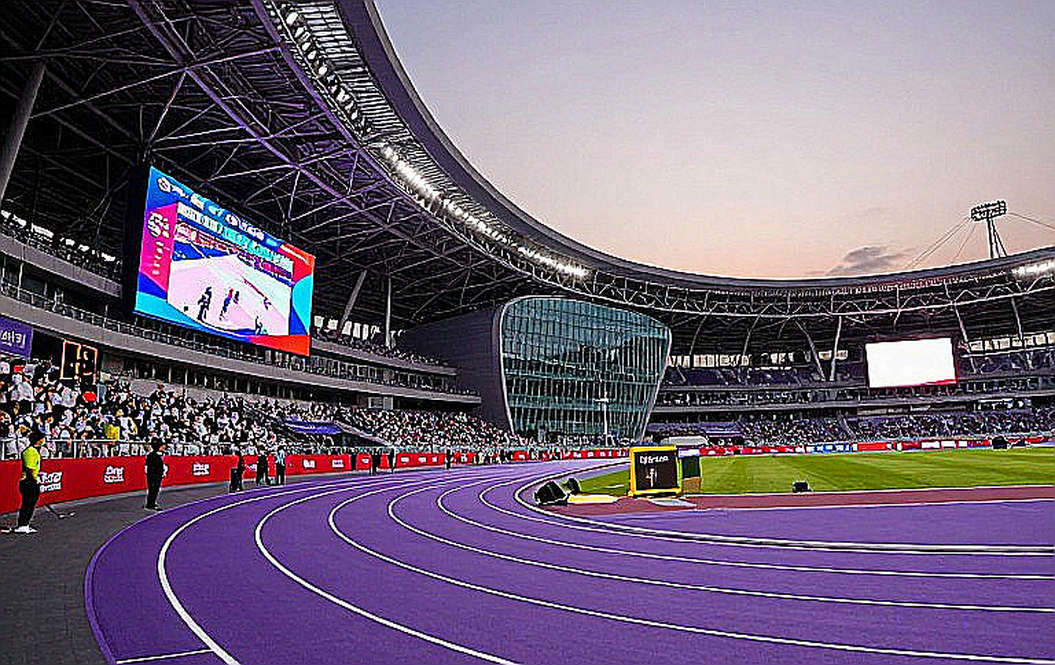
The fifth Asian Para Games gathers roughly three thousand athletes across eighteen sports. Structurally, it is a continental multi-sport Paralympic event, below the Paralympic Games and at or slightly below the World Para Athletics Championships. Its value is developmental and experiential, rather than global prestige.
With a contingent of only twenty, entering an arena of three thousand across eighteen sports, the operational problem becomes far more significant than a press release suggests. A small delegation must carry enough medical, coaching, classification and logistics staff for nine different sports — a fixed cost spread over very few athletes. Singapore accepts that cost, and that acceptance says something: international presence is treated as an end in itself, not merely a means to medals.
At continental level, the power picture is clear. China is the dominant force in Asian para athletics, with athletes spread across most classification classes. Japan — as host — along with Iran, India and Uzbekistan form a strong chasing group. Thailand, Malaysia, Vietnam and Kazakhstan are sports systems with selective targets. Singapore sits at the edge of that picture, as a small delegation pursuing specific events.
This note matters for one reason: it helps read the position of the two Singaporean athletics entrants without inflating or diminishing them. They enter a field with great depth, where every technical class has opponents from national sports systems many times larger.
Two athletics names and the classification gap
James Ethan Ang, twenty-five, and Muhammad Diroy Noordin are Singapore's only athletics representatives at Aichi-Nagoya. For someone who writes about athletics, this is where I have to stop longest — and where I am most puzzled.
The release provides no performance metric whatsoever. No personal best. No season best. No time, no distance, no height. And most importantly for para athletics: no classification code.
In para athletics, every athlete is placed in a competition class, denoted by a letter and a number. The letter T covers track events, F covers field events, and the accompanying number identifies the impairment group and how it affects movement. A classification code is not administrative paperwork. It determines which events an athlete can enter, who their direct opponents are, and whose marks are legitimate comparisons.
Without a classification code, a reader cannot know whether Ang runs, jumps or throws; cannot know whether Diroy Noordin competes in a seated or standing class; and cannot know which record is a valid reference point.
This is not a minor detail. It is the entire frame of reference for the discipline.
Still, one signal, however weak, can be read. The fact that Ang, twenty-five, was chosen as Singapore's flag bearer suggests he occupies a certain position within the national Paralympic system — in profile, in promise, or in a next-generation leadership role. In multi-sport contingents, flag bearers are often chosen on a balance of reputation, potential and inspirational capacity. This is inference based on convention, not data stated in the source, so it should be read cautiously.
At twenty-five, in a sport whose career trajectory often starts later due to long classification and development pathways, Ang sits in the ascending band of the career curve. That is a reasonable principle-based read. But it does not replace data.
The flag bearer problem
Awarding the flag-bearer honour to a twenty-five-year-old para athlete, in a contingent that also includes former Paralympic medallists, opens several interpretations. The first is technical: Ang is assessed as having the strongest competitive prospect in the group. The second is symbolic: the committee wants to send a next-generation message. The third combines both, when a face has both competitive potential and communications fit.
None is confirmed in the source. But one detail stands out: the flag bearer was honoured at a ceremony attended by a minister, at a symbolic Singapore venue. That indicates a state-level event, with formal backing from national sports bodies, not a purely volunteer-led activity.
For a young athlete placed in that position, the pressure is real and unquantifiable. Flag-bearer honours often carry public expectation, even if only moderately. In Paralympic sport, where media attention is generally lower than in able-bodied sport, even modest focus can have an outsized effect relative to its true proportion.
Two veterans switching sports and the long game
Alongside the two athletics names, Singapore's contingent carries two other notable names for a different reason: Jovin Tan, forty, switching to boccia, and Theresa Goh, thirty-nine, switching to shooting.
Both are veteran Paralympic athletes changing competition sports. Jovin Tan previously competed in Paralympic sailing. Theresa Goh previously competed in Paralympic swimming and has a high public profile record. Their departure from their strongest sports into disciplines demanding high technical precision is a signal worth analysing.
Two athletes past their physiological peak switching to boccia and shooting — sports where technical experience outweighs physical power — reveal a directed career-extension strategy, not a random move.
But switching sports in Paralympic competition is far more complex than in able-bodied sport. Every Paralympic sport has its own classification system, administered by the corresponding international federation. A switching athlete must undergo a new classification process, be confirmed eligible for a specific class, and that classification result can be protested through formal procedures.
This means the two athletes almost certainly went through a long preparation period before the contingent was announced, with classification appointments and eligibility confirmation. The source describes none of that. But looking at the background, a successful sport switch requires a specialist apparatus capable of coordinating complex procedures, not just individual determination.
At some level, the existence of these two names says more than the two athletics names. It shows the Singapore Paralympic system can retain athletes, reassign them to sports suited to their career stage, and sustain resources into a new cycle.
Absence of data as a signal
I came to this piece with a professional bias. The scoreboard ends the match, but most of the story lies beneath it. With a selection release, what lies beneath is almost the whole story.
In Paralympic sports journalism, there are two ways to handle a source that supplies no performance data. The first is to fill the gap with emotional discourse, replacing analysis with overcoming-adversity narrative. The second is to name the gap, identify exactly what is unknown and why the unknown matters.
A release naming athletes without performance or classification codes shows Paralympic sport's communication standard is still measured by participation, not performance — the biggest blind spot in this coverage.
In able-bodied athletics, no release names athletes while omitting personal bests. In para athletics, even the classification code — the most basic element for knowing what event an athlete contests — is absent. The difference is not accidental. It reflects an industry habit: telling Paralympic stories through effort rather than numbers, through imagery rather than data.
That way of telling has a subtle harm. It confines readers to the role of sympathetic spectator rather than sports assessor. When you do not know an athlete's classification, you cannot debate them. You can only pity them. And pity is not a foundation for a sport to be respected.
I recall a story from 2026, when I was sixteen and writing my first analysis piece for a young sports platform. I rewatched twenty-four tapes to verify every stride of one athlete, and was told flatly that a female writer did not understand tactics. They said girls don't understand tactics; I wrote so they'd have to read again. That piece drew twelve thousand reads. The lesson that stayed was not about numbers, but about what I chose to do: I chose analysis over sentiment.
That approach applies exactly to a release like Singapore's. If we accept that participation is the whole story, we miss the most important thing about this cycle: how a small system organises resources for an increasingly competitive tier of competition.
What is happening in a release with no medal target
One detail worth analysing: the release announces no medal target.
In sports governance, setting or not setting a target is a strategic decision. Setting a target creates pressure on athletes and a framework for media to judge success or failure. Not setting one keeps expectations open, meaning evaluation will rest on other criteria — finals appearances, personal records set, and the maturity of debutants.
That internal evaluation is reasonable for a contingent with forty percent debutants and only two athletics entrants. It also protects the delegation from being judged a failure by a yardstick unsuited to its scale.
But there is another side. Not setting a target is an indirect way of saying the medal table is not the priority. For a country with a sports system developed enough to compete in specific events, this caution is both risk insurance and a sign that team depth does not yet allow a pursuit of standing.
How a delegation announces its composition without a target shows it measures success by how many athletes are retained beyond the cycle, not by medals brought home.
That means more for Singapore than for many others, because its sports system is tightly organised, clearly state-backed, and has a history of retaining athletes across cycles. If the goal is building a sustainable talent pipeline, a Games without a target is a sensible investment.
One personnel detail deserves note: Low See Lien is Singapore's Chef de Mission for this Games and also Vice-President of the Singapore National Paralympic Committee. She previously served as Chef de Mission at the 2026 ASEAN Para Games. A vice-president taking the Chef de Mission role signals seriousness of organisation, and reflects a trait of the Singapore Paralympic system: senior leadership directly involved in operations, not merely policy.
Continuity in leadership is a stabilising factor. Games-management experience in a small nation, where every delegation must optimise resources, has more practical value than in a well-resourced sports system.
Athletics as the common language of lines not yet drawn
Back to the two athletics names. James Ethan Ang, twenty-five, the flag bearer. Muhammad Diroy Noordin, the second in the contingent. In mid-October, on the Aichi-Nagoya track, these two will compete while most of the world does not know what class they race in, whom they face, or what their reference marks are.
Results will be recorded. Their marks will sit in some results list. But before that happens, the story still has no frame.
I have learned this after years of working with Paralympic athletes: a data gap is not proof of weakness. Sometimes it is simply a sign of an industry that has not yet learned to ask the right questions. People call weak teams underdogs; I call them storytellers on the pitch. For para athletics, that story needs to be told with technique, not only sympathy.
Aichi-Nagoya will be a short chapter. The Games last seven days and will close quickly, after which international media will shift elsewhere. But two things will last longer than those seven days: first, the question of Ang's and Diroy Noordin's classification — a question a full results sheet will answer. Second, the question of whether a twenty-person, nine-sport delegation weighted toward forty percent debutants is the model Singapore needs for the next cycle.
From a writer's perspective, I choose to believe the second. The Singapore National Paralympic Committee not publishing a medal target is not because it lacks ambition. It chose not to grind a long-term goal into a short-term number. In a cycle where forty percent of the contingent are first-time Games participants, a young face carries the flag, and two veterans rebuild careers in new sports, time is the only asset that cannot be bought with resources.
On September 12 at Gardens by the Bay, a red-and-white flag was handed over. Seven weeks later, in Aichi-Nagoya, it will be raised at the opening ceremony. After that, twenty Singaporean athletes will step into the biggest arena most of them have ever touched — some for the first time. And when the Games close, what remains will not be medals, but how many of those twenty return with a new cycle in their heads.
I write about passes to tell stories about choices in life. At Aichi-Nagoya, that pass is called patience.